- Conditions
- Full sun, fertile soil, zones 5-8
- Flowering
- Late spring to late summer
- Maintenance
- Medium - deadhead the rose, shear catmint
- Positioning
- Rose on a fence or arbor behind, foxglove in the middle, catmint and lady's mantle at the front
What is a cottage garden?
A cottage garden is a loose, generous mix of flowers, herbs and climbers packed into beds with almost no bare soil showing. The style began in English villages, but America has its own long tradition of it: the dooryard gardens of New England, Southern grandmothers' gardens of zinnias and four o'clocks, and today's pollinator gardens full of native coneflowers and bee balm. It is forgiving and informal, which makes it one of the friendliest styles for beginners.
Layered planting
Tall, medium and low plants stacked so the bed looks full from front to back.
Dense, soft beds
Plants grow into each other, leaving little bare soil and few gaps for weeds.
Flowers, herbs & climbers
Roses and perennials mixed with fragrant herbs, with a climber on every fence post and arch.
Pollinator-friendly
Nectar-rich, informal planting busy with native bees, butterflies and hummingbirds all season.
Paths & arches
A winding path, a picket fence and an arbor covered in roses give the abundance some structure.
Old-fashioned charm
A timeless, slightly wild look, full of heirloom flowers and self-sown surprises.
How it compares to other garden styles
Cottage Garden
Romantic and informal. Dense, layered beds of flowers, herbs and climbers.
You are hereFormal Garden
Symmetry, clipped hedges and structure. Tidy, restrained and architectural.
Wildlife Garden
Native, habitat-led planting, left a little wild for birds and insects.
Mediterranean Garden
Sun-loving, drought-tolerant planting with gravel, silver foliage and herbs.
Tropical Garden
Bold leaves and exotic shapes for a lush, dramatic, jungle-like feel.
Cottage gardens in pictures
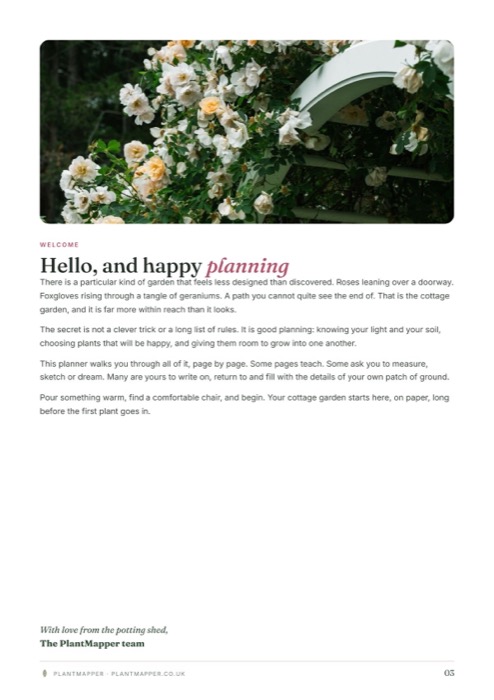
A little inspiration before you plan: climbing roses, packed perennial beds and the soft, abundant look that defines the cottage style.
The cottage garden design formula
Cottage gardens look spontaneous, but the best ones follow a simple recipe. Include a little of each layer below and your beds will feel full, balanced and colorful for months.
Tall background spires
Height at the back: hollyhocks, foxgloves, delphiniums in the North, and native Joe Pye weed or tall garden phlox.
Mid-height flowering plants
The heart of the bed: peonies, garden phlox, bee balm, coneflowers and hardy geraniums.
Front-of-bed edging
Soft, low plants that spill over the edge: catmint, lavender, lady's mantle and dianthus.
Climbers
Climbing roses, clematis and native coral honeysuckle on fences, arbors and porch posts.
Evergreen structure
A few evergreens such as boxwood or native inkberry holly hold the garden together in winter.
Pollinator plants
Nectar-rich flowers such as coneflower, butterfly weed, black-eyed Susan and asters feed bees and monarchs.
Herbs and fragrance
Lavender, thyme, sage and old roses near paths and the porch so the garden smells wonderful.
Spring bulbs
Daffodils, snowdrops and alliums for early color before the perennials wake up. Daffodils are deer-proof.
Cottage gardens across the US
The cottage look works almost everywhere, but the plant list changes a lot between Vermont, Georgia and Arizona. Find your growing zone and choose plants rated for it.
Northeast & Midwest
Classic cottage territory. Peonies, delphiniums, lupines, hollyhocks and phlox love the cold winters. Deer pressure is high in much of the region, so lean on catmint, foxglove, bee balm and daffodils, and watch for Japanese beetles on roses and hollyhocks in July.
Southeast & Gulf Coast
Heat and humidity rule out delphiniums, lupines and lamb's ear. Use zinnias, salvias, coneflowers, black-eyed Susans, mildew-resistant phlox, old Southern roses and native coral honeysuckle. Plant perennials in fall so they root in before summer.
Southwest & California
Dry heat and alkaline soil call for a dryland cottage garden: penstemon, blanket flower, desert marigold, salvias, lavender and California poppy, on drip irrigation with gravel or bark mulch. Avoid red valerian near wildlands in California, where it can spread.
Pacific Northwest
Mild, damp weather suits English-style cottage plants almost perfectly. Foxgloves and some other favorites self-seed heavily here, and English ivy and butterfly bush are invasive, so choose sterile cultivars or natives like red flowering currant and Pacific bleeding heart.
Mountain West & Plains
Cold winters, wind and dry air. Hardy choices include hollyhocks, peonies, catmint, Russian sage, penstemon, blanket flower and coneflower. Stake tall plants against wind and water deeply but infrequently.
Native plants for a cottage garden
North American natives slip easily into a cottage bed, are tough in local conditions and feed the native bees, butterflies and hummingbirds that European favorites often don't. Six favorites to start with:
Purple coneflower
Echinacea purpurea, zones 3-9. Long summer bloom, loved by bees and butterflies, then seedheads for goldfinches.
Bee balm
Monarda didyma, zones 4-9. Shaggy red, pink or purple flowers for hummingbirds; deer leave it alone. Choose mildew-resistant varieties.
Black-eyed Susan
Rudbeckia fulgida and R. hirta, zones 3-9. Golden daisies from midsummer to fall, tough in heat and clay.
Wild columbine
Aquilegia canadensis, zones 3-8. Nodding red and yellow spring flowers for early hummingbirds, happy in part shade.
Butterfly weed
Asclepias tuberosa, zones 3-9. Bright orange flowers and a host plant for monarch caterpillars. Deer resistant and drought tolerant.
Coral honeysuckle
Lonicera sempervirens, zones 4-9. A well-behaved native climber for hummingbirds, the right choice instead of invasive Japanese honeysuckle.
Flower bed plant calculator
Work out roughly how many plants you need to fill a new bed, and how to split them between tall, mid-height and front-of-bed layers.
How many plants will my bed need?
Enter your bed size in feet and a planting style, then press calculate.
Handy when planting a new bed
Our picksAs an Amazon Associate, PlantMapper may earn from qualifying purchases. Prices and availability are set by Amazon.
Soil type finder
Your soil decides which plants will thrive. Answer two quick questions and we'll suggest your soil type, cottage plants that suit it and how to improve it.
What type of soil do I have?
Dig a small hole, take a handful of moist soil and answer below.
Handy for improving your soil
Our picksAs an Amazon Associate, PlantMapper may earn from qualifying purchases. Prices and availability are set by Amazon.
Sunlight & exposure finder
Most cottage plants love sun, but there is a lovely palette for shade too. Tell us which way your bed faces and how shaded it is.
How much sun does my bed get?
Choose the direction it faces and how shaded the spot is.
Flowering gap planner
A great cottage garden has something in bloom for as many months as your climate allows. Tap the months you already have flowers and we'll suggest plants to fill the gaps.
When does my garden have flowers?
Tap each month you already have something in bloom.
Handy for filling seasonal gaps
Our picksAs an Amazon Associate, PlantMapper may earn from qualifying purchases. Prices and availability are set by Amazon.
Cottage garden plant finder
Browse beginner-friendly cottage plants, including North American natives and deer-resistant choices, and filter by your conditions. Tap any filters that apply and combine a few to narrow the list.
- shown
No plants match every filter at once. Try removing one; for example, Full Sun and Shade can't both be true.
Planting combinations that just work
Not sure what goes with what? Each of these groupings is chosen to grow well together and flower in harmony. Check each plant's zone range for your area.
- Conditions
- Full sun, well-drained loam, zones 4-8
- Flowering
- Late spring to late summer
- Maintenance
- Medium - choose mildew-resistant phlox
- Positioning
- Phlox at the back, peony in the middle, lavender and geranium edging
- Conditions
- Sun to part shade, heavy clay, zones 4-8
- Flowering
- Summer to fall
- Maintenance
- Low - all four are tough North American natives
- Positioning
- Aster and bee balm for height, coneflower and black-eyed Susan in front
- Conditions
- Full sun, well-drained or poor soil
- Flowering
- Early summer to fall
- Maintenance
- Low - little water once established, rarely touched by deer
- Positioning
- Russian sage at the back, catmint in the middle, lavender and lamb's ear at the front
- Conditions
- Part shade to shade, moist soil rich in organic matter
- Flowering
- Late winter to early summer across the group
- Maintenance
- Low - a light tidy in late winter
- Positioning
- Ferns and columbine for height, hellebore and pulmonaria layered to the front
- Conditions
- Full sun, well-drained soil
- Flowering
- Early summer to fall
- Maintenance
- Low - leave seedheads for goldfinches in winter
- Positioning
- Anise hyssop and coneflower in the middle, butterfly weed and sedum in front, catmint edging
Cottage garden care calendar (zones 5-7)
One simple job a month keeps a cottage garden looking its best. Timing is for zones 5-7: in zones 8-10 most jobs come 4-6 weeks earlier in spring and later in fall, and in zones 3-4 a few weeks later in spring. The current month is highlighted.
Order seeds and plan; in zones 8-10, plant bare-root roses now.
Prune most roses and cut back old perennial stems as buds swell.
Add compost and mulch as growth begins; divide summer bloomers.
Put in plant supports and peony rings before plants need them.
Plant annuals and tender plants after your last frost.
Sow biennials such as foxgloves and hollyhocks for next year.
Deadhead, water deeply in dry spells and hand-pick Japanese beetles.
Collect ripe seed from favorite plants such as zinnias and hollyhocks.
Divide crowded spring and early summer perennials and plant new ones.
Plant spring bulbs such as daffodils, alliums and crocus.
Plant tulips, then leave seedheads standing for birds.
Mulch after the ground freezes and protect roses in cold zones.
Tools for year-round cottage garden care
Our picksAs an Amazon Associate, PlantMapper may earn from qualifying purchases. Prices and availability are set by Amazon.
Common cottage garden mistakes
Every gardener makes these at first. A little awareness now saves a lot of disappointment later.
!Too much bare soil
Cottage beds look best packed. Bare patches invite weeds and look sparse, so plant generously.
!Forgetting supports
Tall plants flop without staking. Put supports in early, before the plants need them.
!Ignoring your soil
Plants chosen to suit your soil thrive. Fighting your soil type rarely ends well.
!Planting for deer to eat
Roses, phlox, hostas and tulips are deer favorites. Where deer roam, lean on catmint, lavender, foxglove, daffodils and many natives.
!No evergreen structure
Without evergreens the garden disappears in winter. Add a few for shape all year.
!Overcrowding
Abundance is the look, but plants set too close compete and get mildew. Respect mature spread.
!Fussy plants first
Delphiniums and lupines sulk in hot, humid summers. Start with plants proven in your zone and build up.
!Ignoring mature size
That small nursery pot can become a 6 ft shrub. Check final height and spread before planting.
!Planting invasives
Some old favorites, such as Japanese honeysuckle, sweet autumn clematis and multiflora rose, are invasive in much of the US. Check your state's list.
!Poor flowering succession
Everything blooming at once leaves long gaps. Stagger plants for color from spring to fall.
A cottage garden, fully grown in
Give the planting a season or two and the beds knit together into the soft, abundant, slightly wild look that makes the cottage style so loved.
Helpful kits for cottage gardeners
Grouped suggestions to get you started, organized by job. All optional: every tool here can be borrowed, bought secondhand or added over time.
The links in this section are paid affiliate links. If you buy through them we may earn a small commission, at no extra cost to you. We only suggest genuinely useful items.
Beginner Tool Kit
- Hand trowel & hand cultivator
- Bypass pruners
- Gardening gloves
- Watering can
Soil Preparation Essentials
- Garden compost
- Composted manure
- Soil conditioner
- Shredded bark mulch
Pollinator Extras
- Native plant plugs
- Native bee house
- Native wildflower seed mix
- Shallow water dish
Download the Cottage Garden Starter Kit
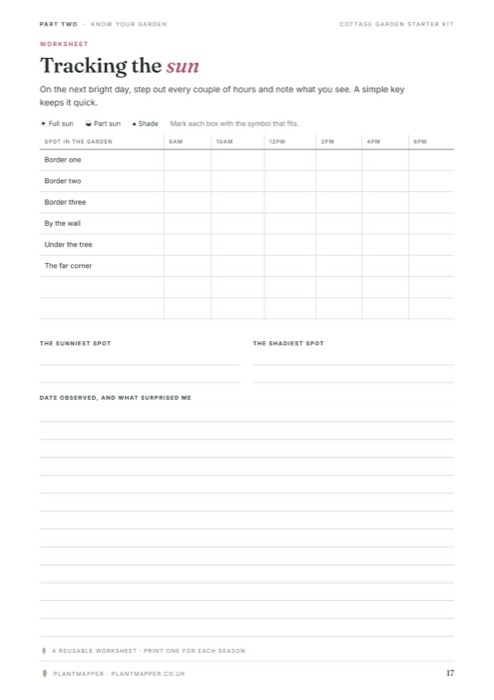
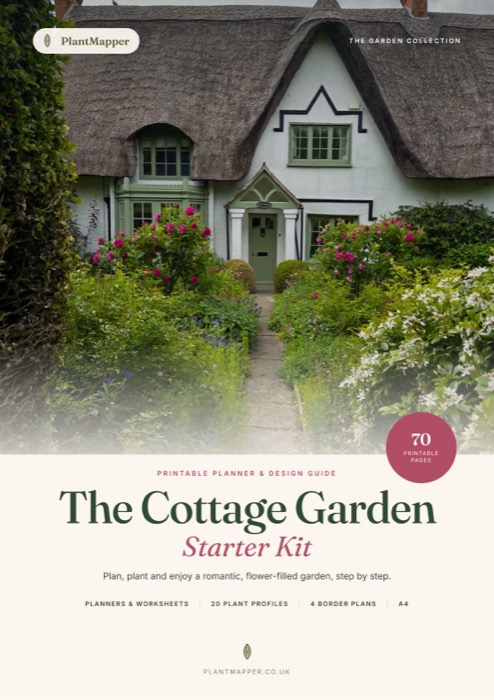
An instant digital download in A4 and US Letter. Print it at home as often as you like and plan a layered cottage bed every year, with a full cottage-plant directory, ready-made and blank bed plans, a year-round flowering timeline, design grids, gentle seasonal checklists and soft, romantic color palettes ready to copy. Part of the wider PlantMapper Collection, alongside our Mediterranean, Tropical and Shady garden kits.
Download the Starter Kit on Etsy (UK edition)
70-page printable planner · A4 & US Letter
Disclosures & disclaimers
Affiliate disclosure
Some links on this page are affiliate links. If you buy through them, PlantMapper may earn a small commission at no extra cost to you. This never changes which products we suggest.
Gardening disclaimer
All planting advice is general guidance for gardens in the United States. Results vary with your zone, soil, heat and humidity, so always confirm a plant suits your conditions and is not on your state's invasive plant list.
Plant toxicity disclaimer
Several cottage plants, including foxglove, delphinium, lupine, hellebore and butterfly weed, are toxic if eaten or can irritate skin. Check each plant before growing it near children, pets or food crops, and wear gloves when handling.