
Lavender
Lavandula angustifolia
Fragrant, deer-resistant and loved by bees, for zones 5-8. It thrives in dry Western heat; in the humid Southeast, grow it in a pot or raised bed with gritty mix so it doesn’t rot.
Lots are getting smaller across the US - townhouse yards, zero-lot-line homes, urban backyards and condo balconies are where millions of people garden now. The good news: a small space is quicker to plant, cheaper to fill and easier to keep looking great. Plan the layout, grow up the fences as well as across the ground, pick compact plants that suit your zone, and even a 10-by-12-foot patio can feel lush, private and genuinely useful.
Small spaces reward restraint. A few good plants and one or two strong ideas, carried through, always beat a crowded patio trying to fit everything in.

In American terms, a small garden might be a fenced townhouse yard, the side yard of a city lot, a rowhouse patio, a rooftop, a condo balcony or the bare rectangle of sod behind a new-construction home. Each comes with its own limits - HOA rules, compacted builder soil, weight limits, wind, shade from the neighbors’ houses - but all share the same advantages: less to buy, less to water and weed, and every plant close enough to enjoy. Treat the size as a design brief rather than a disappointment and it becomes the most-used room you have.
You can transform a small yard in a weekend, and the budget stretches to a few really good plants and containers instead of dozens of cheap ones.
Less ground means less weeding, mowing and watering - and a smaller water bill. Upkeep takes minutes, not weekends.
Fences and walls hold warmth, so a small enclosed yard can be half a zone milder than open ground - room to try plants that are borderline for your area.
Up close, details shine - a beautiful planter, a fragrant vine, one perfect small tree. Quality matters more than quantity.
A few pots of native flowers bring in bees, butterflies and hummingbirds, even several floors up. Small yards make real stepping stones for wildlife.
Close to the back door, a small yard becomes an everyday extra room - for morning coffee, dinner off the grill or a quiet evening.
Small yards, patios and balconies planned to feel lush, useful and bigger than they are.
You are hereEasy-care planting and less lawn - ideal for keeping a small yard sharp with little work.
Minimal and contemplative - the courtyard tradition was made for small, enclosed spaces.
Clean lines and clever zoning - contemporary design loves a compact, urban plot.
Native flowers, water and shelter - even a few pots bring a tiny yard alive.
A few images to spark ideas - containers, vines and clever corners that make a small patio feel green, full and welcoming.


Six principles do most of the work. Follow them and even a tiny lot or a fifth-floor balcony feels planned, generous and complete.
Restraint is everything in a small space. A limited palette of plants and materials, repeated, looks calm and intentional - not cramped.
When floor space runs out, go vertical. Fences, walls and trellis double your planting area without using any ground.
A single bold feature - a tree, a water bowl, a beautiful pot - gives the eye somewhere to rest and makes a small space feel designed.
Even a tiny yard can have a place to sit, a place to grill and a place to plant. Give each part a purpose and it feels bigger.
Each plant must give a lot - a long bloom season, fall color, winter structure or food for pollinators. No passengers.
A clean, uncluttered floor - good pavers, neat edges, the hose and trash cans out of sight - makes a small yard feel calm and larger.
A small yard can feel far larger than its square footage. None of these tricks costs much - they guide the eye and play with light, depth and perspective.
An outdoor mirror on a fence doubles the greenery and bounces light into dark corners. Angle it slightly so birds don’t fly into the reflection.
Setting pavers or a path on the diagonal leads the eye across the longest dimension of the lot, making the yard feel wider and deeper.
Too many colors and materials make a small space feel busy and boxed in. A calm, limited palette reads as larger and more restful.
Screen off part of the yard so it can’t all be seen at once. A path that disappears around a corner hints at more space.
Pale fences, light pavers and silver or variegated foliage reflect light and recede, opening up a small or shady yard.
Frame a neighbor’s tree, a park or a city skyline through a gap in planting, and the view beyond becomes part of your yard.
Lead the eye, don’t block it. The fastest way to make a small garden feel bigger is to draw the eye to the far boundary - with a path, a focal point or a mirror - rather than crowding the middle and stopping it short.
In a small yard, fences and walls are as valuable as the ground. Planting upward turns a bare privacy fence into a green, flowering surface. Choose climbers carefully, though: several popular vines are invasive in the US. In a rental or condo, use freestanding trellis rather than drilling into walls.
Clematis, climbing roses, native coral honeysuckle and (in zones 8-10) star jasmine cover fences in flower. Avoid Japanese honeysuckle, sweet autumn clematis, Chinese wisteria and English ivy - all invasive in parts of the US.
A panel of trellis or a slim obelisk adds instant height and a support for climbers - structure and greenery in almost no floor space.
Fence planters, pockets and modular living-wall systems turn a blank fence into herbs, ferns and trailing plants at eye level. Drip irrigation makes them practical in hot summers.
Plant stands, ladder shelves and tiered racks stack pots upward, fitting a whole collection into the footprint of a single container.
Hanging baskets and railing planters bring color up to head height - perfect for porches and balconies. On a balcony, make sure nothing can fall or drip onto neighbors below.
Slim columnar trees - ‘Taylor’ eastern red cedar, columnar hornbeam or arborvitae - screen for privacy without the width of a hedge.
When you see the whole yard from the kitchen window, it needs to look good every day. What “four seasons” means varies - snow in Minneapolis, a mild green winter in Atlanta, a dry summer rest in Los Angeles - so plan for the seasons where you live, and choose plants that perform for months, not weeks.
Plant bulbs in fall for an early lift. Daffodils and alliums shrug off squirrels and deer; tulips and crocus often get eaten. In zones 8-10, chill tulips in the fridge or treat them as annuals.
Long bloomers - salvia, hardy geranium, coneflower and a vine in flower - carry the yard through its busiest months and feed bees and butterflies.
A small Japanese maple or serviceberry, native grasses and asters bring fall color and seed heads for birds - a second peak in miniature.
Evergreens, winterberry holly’s red berries and grasses left standing keep the yard furnished - and feed cardinals and chickadees.
Build around a few evergreens so the yard is never bare - inkberry or dwarf yaupon holly, a compact conifer or, in mild zones, a pittosporum.
Favor plants with two or more seasons - serviceberry (spring flowers, summer berries, fall color) or oakleaf hydrangea (flowers, then red fall leaves).
Plant for the view you live with. In a small yard you see every plant every day. A few plants that look good for months will always beat many that peak for two weeks.
The best small-space plants stay compact, perform for a long season and are happy in containers. These ten are reliable in much of the country - check each zone range against yours with the zone finder, and filter the wider range in the Plant Finder.
Lavandula angustifolia
Fragrant, deer-resistant and loved by bees, for zones 5-8. It thrives in dry Western heat; in the humid Southeast, grow it in a pot or raised bed with gritty mix so it doesn’t rot.
Heuchera
A North American native (coral bells) with leaves in lime, amber, plum and silver, for zones 4-9. Perfect for shady patio pots; the flowers draw hummingbirds.
Geranium ‘Rozanne’
Blue flowers from early summer until frost in zones 5-8, spilling over pot rims and bed edges. It sulks in hot, humid zone 9 summers.
Acer palmatum
A slow, graceful small tree for zones 5-8 with stunning fall color. Give it afternoon shade in hot regions. For a native alternative, try a multi-stem serviceberry.
Salvia nemorosa
Purple-blue spikes from late spring, rebloom after a midsummer trim, and deer usually leave it alone. Hardy in zones 4-8 and very drought-tolerant once established.
Hakonechloa macra
A soft, cascading grass for shade in zones 5-9 that spills over pot edges and glows gold in fall. Slow to spread and not invasive.
Hydrangea paniculata
Hardy to zone 3, with compact varieties such as ‘Bobo’ made for small yards. For a native choice, oakleaf hydrangea adds red fall leaves in zones 5-9.
Clematis
Huge flower power from a square foot of soil, climbing a trellis or obelisk. Large-flowered hybrids suit most zones; avoid sweet autumn clematis, invasive in much of the East.
Erigeron karvinskianus
Tiny pink-and-white daisies all summer, for roughly zones 7-10. It self-seeds freely and has naturalized in coastal California and Hawaii - keep it out of wild areas there.
Fatsia japonica
Huge, glossy leaves for a shady corner, hardy in zones 7/8-10 - a Southern and West Coast favorite. In colder zones, grow it in a container and bring it in for winter.
Skip these small-space “favorites”: Japanese barberry (banned from sale in several Northeastern states), butterfly bush in the Pacific Northwest (restricted in Oregon and Washington - choose seedless cultivars or native alternatives), and English ivy anywhere it can reach a woodland. Native swaps that suit small yards: dwarf fothergilla, ‘Little Henry’ Virginia sweetspire, compact ninebark, coneflower and butterfly weed.

Containers are the small-space gardener’s best tool. They put plants on patios, front stoops, decks and balconies, let you move tender plants inside before a freeze, and lift plants out of the compacted clay common in new subdivisions. A few habits keep them thriving.
Bigger containers hold more potting mix and moisture, so plants grow better and dry out more slowly in summer heat. One 20-inch pot beats three 10-inch ones.
Cluster pots in odd numbers and varied heights, rather than dotting them about. A grouped collection reads as a planted border, not scattered pots.
Use a good bagged potting mix; garden soil compacts in pots and drowns roots. Add perlite or pumice for lavender and succulents.
Pots can need water daily in a Southern or Western summer - a drip kit on a hose-bib timer makes it effortless - and fertilize through the season for nonstop flowers.
Keep a few pots by the front door for seasonal swaps - pansies, then summer annuals, then mums and pumpkins, then evergreen boughs for the holidays.
In zone 6 and colder, terracotta can crack in winter; fiberglass, resin and thick glazed pots last longer. A few matching containers look calmer than a jumble.
A little tree in a big pot - a Japanese maple, a dwarf conifer, or an olive or Meyer lemon in mild zones - gives a small yard instant height and a centerpiece. On a balcony, check the weight limit first: wet soil weighs roughly 100 lb per cubic foot.
You don’t have to give up the style you love because the space is small. Most garden styles scale down well - here is how, with links to the full guides as they become available.
A container water feature, a few native flowers and a host plant like butterfly weed bring bees, monarchs and hummingbirds to the tiniest yard.
Wildlife Garden guide →A sunny, sheltered patio suits gravel, terracotta, herbs and silver foliage - and in California and the Southwest it is also the most water-wise choice.
Mediterranean Garden guide →The Japanese courtyard (tsubo-niwa) tradition was made for small spaces - a maple, a basin, a rock and moss create complete calm.
Japanese Garden guide →Evergreen structure, ground cover and a deep mulch keep a compact yard looking sharp for the least possible work.
Low-Maintenance guide →Drought-tolerant planting through gravel suits a small, sunny, fast-draining lot - relaxed, water-wise and almost self-sustaining.
Gravel Garden guide →Clean lines, bold planters and clear zones make a compact city lot feel sharp, calm and contemporary.
Modern Garden guide →Most small-yard problems come from trying to fit too much in, or from plants that are too big or too aggressive for the space.
The biggest mistake of all. Too many plants, pots and features make a small yard feel cluttered and smaller still. Edit hard - less really is more.
A bare privacy fence wastes half your yard. Cover it with non-invasive vines and fence planters to double the greenery.
A jumble of every color and material feels busy and boxes the space in. A calm, limited palette always reads as larger and more restful.
That cute 1-gallon shrub may hit 10 feet. Check the mature size on the tag, choose dwarf varieties, and avoid aggressive spreaders like bamboo and invasive vines.
Tiny pots dry out in hours and starve their plants. Fewer, bigger containers grow far better plants and look bolder and more designed.
Planting every inch and leaving nowhere to sit is a missed chance. Always keep room for a chair or two - a yard is for enjoying.
Four starting points for the most common small American spaces - copy one, or adapt it to your own patio, balcony or lot.
A fenced patio is the easiest small space of all - lush, green and private, a calm outdoor room just beyond the back door.
No soil needed - a few grouped containers and a planted railing turn a bare balcony into a green retreat, even several floors up.
The forgotten strip between houses becomes a green corridor - lead the eye to the far end and it feels longer and full of purpose.
A bare subdivision lot is a blank canvas - fix the soil, frame the edges, keep the middle open and cover those new fences to make it feel established fast.

Filter plants by your zone, light and soil so everything you buy suits your yard. These shortcuts are a good place to start.
Work out plant numbers, potting mix and materials in square feet and cubic feet with our free calculators.
As an Amazon Associate, PlantMapper may earn from qualifying purchases. Prices and availability are set by Amazon.
Use every fence, corner and container and let the planting fill in, and even the tiniest lot becomes a green, private retreat that feels far bigger than it is.

This guide is free in full. If you prefer to plan on paper, the Small Garden Starter Kit is an optional printable workbook with layouts, design grids and planting plans. It is the original edition, so check its plant picks against your zone and this page, and use our free garden calculators and Plant Finder alongside it.
Measure up, read your light, and plan how to zone, screen and plant a compact yard so every square foot earns its place.
Scaled grids for drawing a patio, small yard or balcony to size, with a key for pots, vines and a place to sit.
Ready-made and blank plans for pots, raised beds and small borders, with compact, long-season combinations.
Profiles of compact, multi-season plants for pots, fences and small beds - check each against your USDA zone.
Season-by-season checklists for watering, fertilizing and swapping containers - the few small jobs that keep it looking good.
Pages to record what thrived in your containers and corners and what to try next, season by season.
An instant digital download that prints on US Letter (or A4) paper at home, as often as you like. Inside you will find the PlantMapper 5×5 formula, twenty small-garden layouts by plot shape, space-making and zoning worksheets, scaled design grids, a compact multi-season plant directory and gentle seasonal care checklists. It sits alongside our Cottage, Mediterranean, Tropical, Shady and Wildlife garden kits.
Download the Starter Kit on Etsy (UK edition)A printable workbook for your own space. A small yard, planned with care, can be the most rewarding space of all.
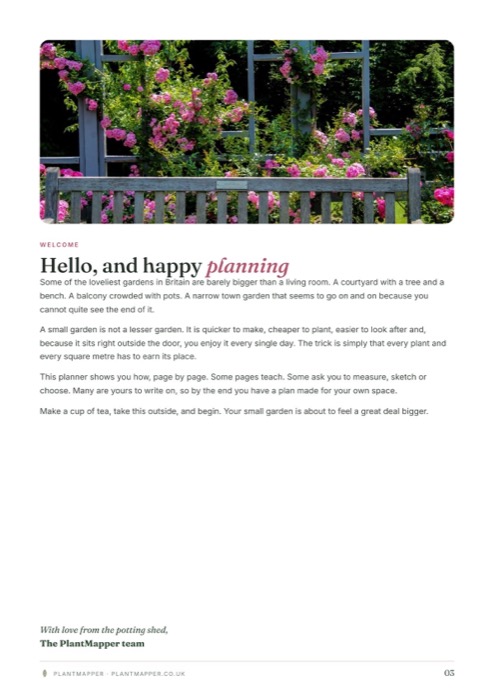
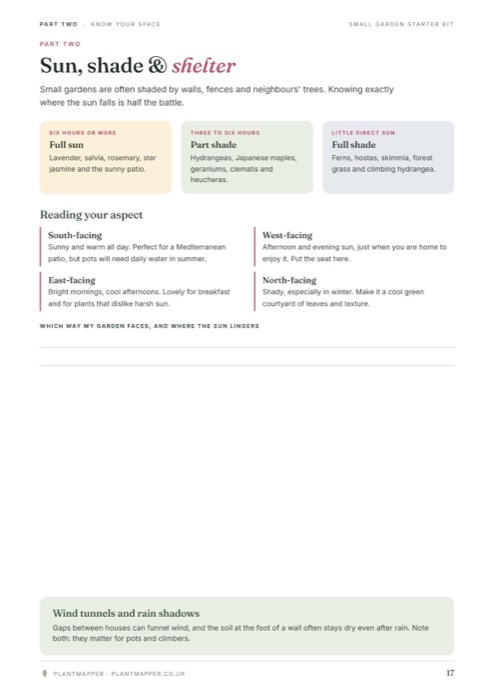
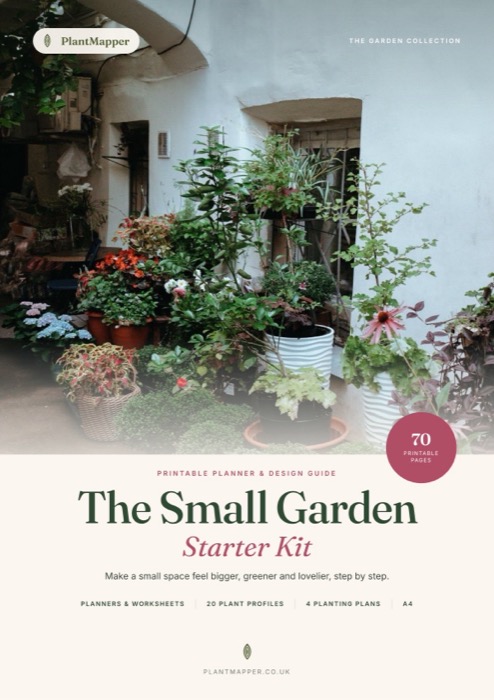 70-page printable planner · A4 & US Letter
Any compact outdoor space: a townhouse or rowhouse yard, a city lot, a side yard, a patio, a deck, a rooftop or a condo balcony. With good planning a small space can be as useful and beautiful as a big yard - and it is cheaper and quicker to plant and look after.
Keep to a few colors and materials, lay pavers or a path on the diagonal, grow up fences and trellis, use pale surfaces and an outdoor mirror to bounce light, screen part of the space so it can’t all be seen at once, and choose one strong focal point rather than lots of small decorations.
Compact plants with a long season that suit your USDA zone: coral bells (a North American native), lavender, hardy geranium, salvia, compact panicle hydrangea, Japanese forest grass, serviceberry or Japanese maple as a small tree, and a non-invasive clematis for height. Native shrubs such as dwarf fothergilla and ‘Little Henry’ sweetspire are excellent too. Repeat a few plants rather than buying one of everything.
Japanese honeysuckle, sweet autumn clematis, Chinese and Japanese wisteria, porcelain berry and English ivy are invasive in many parts of the US. Better choices include native coral honeysuckle, American wisteria, climbing hydrangea, large-flowered clematis hybrids, climbing roses and, in zones 8-10, star jasmine. Check your state’s invasive plant list for local rules.
Usually, but check your HOA, building or lease rules first - many limit container size, railing planters, drilling and watering. Wet soil weighs roughly 100 lb per cubic foot, so use lightweight fiberglass or resin pots, keep heavy planters near the wall rather than the edge, and use saucers so water doesn’t drip onto neighbors below.
Slim, columnar plants screen without eating ground space: ‘Taylor’ eastern red cedar (a native juniper), columnar hornbeam, narrow arborvitae, or a trellis panel covered with a non-invasive vine. Avoid running bamboo, which spreads into neighbors’ yards and is restricted in some towns. Check local fence-height and HOA rules before building screens.
Some links on this page are affiliate links. If you buy through them, PlantMapper may earn a small commission at no extra cost to you. It never affects which products we suggest.
All advice is general guidance for yards across the US. Results vary with your zone, climate, soil and setting - always confirm a plant’s hardiness and invasive status for your state, and check HOA or lease rules before changing a shared space.
Some plants are toxic or have irritant sap. Wear gloves when handling, and check each plant before growing it where children or pets roam, especially in a small space used every day. The ASPCA keeps a searchable list of plants toxic to dogs and cats.