
Japanese maple
Acer palmatum
The signature plant, zones 5-8. Give it afternoon shade, which is essential in the South, and shelter from drying wind. Japanese beetles and deer both nibble it.
Americans have loved Japanese gardens since the late 1800s, and public gardens from Portland to Brooklyn show how well the style travels. At home it comes down to stone, water, a few well-chosen plants and a lot of restraint. You don't need acres or a particular climate: a shady side yard in Ohio, a courtyard in Atlanta or a gravel corner in Phoenix can all become a calm retreat, as long as you choose plants for your zone.
Restraint is the whole trick. Begin with fewer elements than you think you need, place each one carefully and leave open space around it. The calm comes from what you leave out.

A Japanese garden is made to be looked at slowly. It shrinks a landscape down to yard size: a boulder stands in for a mountain, raked gravel for the sea, one maple for a forest. Those pieces are arranged with care and plenty of empty space, color is kept to a few seasonal moments, and texture and shape carry the design. Done well, it is one of the most restful styles you can build, and once established it asks for tidying more than heavy work. The ideas work in any climate; the plants are what you adjust for your growing zone.
Everything is placed to slow you down. It is a garden for a bench and a cup of tea, not for lawn games.
Mountains, rivers and forests are suggested with stone, gravel and a handful of plants, a whole landscape at backyard scale.
Nothing is mirrored or lined up. Elements are balanced by eye, in odd numbers and natural-looking groups.
A few good elements with space around them say more than a yard full of ornaments ever could.
Spring blossom, deep summer green, blazing fall maples and the bare bones of winter: the design marks each season.
Little to water, feed or deadhead once established. Upkeep is light, regular sweeping and pruning.
Stone, water, moss and maples in calm, balanced compositions that look good in every season.
You are hereCool, leafy planting for low light. Maples, moss and ferns love these conditions, especially in hot-summer states.
Drought-tolerant planting through gravel, a natural fit with the dry Japanese garden in the West.
Relaxed, layered planting under trees that shares the same naturalistic, foliage-led spirit.
Easy-care planting with minimal fuss. A structural Japanese garden is undemanding once built.
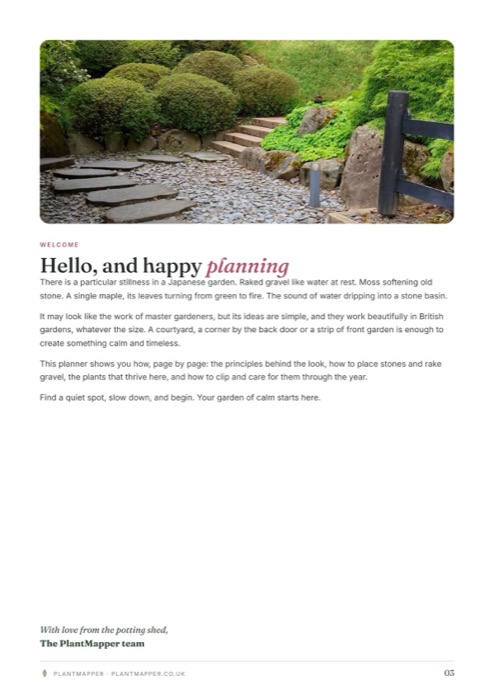
Some inspiration before you start: maples, moss, raked gravel, stone and water arranged for stillness.


A few long-standing ideas sit behind every good Japanese garden. You don't have to follow them to the letter, but knowing them is what separates a convincing garden from a yard with a lantern in it.
Balance by eye, not by mirroring. Group in odd numbers, set focal points off-center and let nothing line up too neatly.
“Shakkei” pulls a neighbor's oak, a distant ridge or open sky into the view, so a small lot feels part of something bigger.
Nature in small: a rock for a mountain, gravel for water, a clipped shrub for a far-off hill.
Elements carry meaning: stepping stones slow your pace, a basin invites a pause, water suggests renewal and time.
“Hide and reveal”: a path that bends out of sight or a view glimpsed through leaves makes even a small yard feel like a journey.
Nothing should look forced. Stones look as if they have always been there, and plants grow as they would in the wild.
If you remember one thing, make it this: a Japanese garden is shaped as much by what you leave out as by what you add. Open space isn't wasted. It lets each element stand out and gives the eye somewhere to rest.
Pick a few elements and stop. One beautiful maple beats five competing shrubs, and one good boulder beats a rock pile.
Leave generous areas of moss, gravel or water empty. The space between things is part of the design.
Balance one large element with two small ones, or a tall plant with a low rock, judged by eye rather than symmetry.
Group in threes and other odd numbers, with varied heights, for a natural, settled look.
When in doubt, take something away. Most Japanese-style yards go wrong by having too much in them. If a corner feels busy, remove something before you think about adding.
Stone and water are the skeleton of the garden. Place them first and they hold everything together; get them right and the planting almost takes care of itself. Local stone usually looks most natural, so check a landscape supply yard near you for boulders and gravel.
The most important element. Set a few good boulders in natural groups of three, buried a third deep so they look settled, not dropped off a truck.
In a dry garden, raked gravel becomes water, flowing around “island” rocks. A great choice in the dry West, where it needs no irrigation.
A still pond, small stream or simple basin adds sound, reflection and life, and birds will use it. Even a water bowl changes a patio.
A low stone basin fed by a bamboo spout, traditionally for rinsing the hands. A recirculating pump makes it an easy focal point with no pond.
Set flat stones in gravel or moss to guide the walk and slow the pace. The gaps make you look down, then up, a deliberate rhythm.
River rock “streams” suggest water and tie areas together, and a dry creek bed can also carry storm runoff.
Place the rocks first. Set your stone before you plant, and call 811 before digging deep holes for boulders or a pond. Everything else is arranged around the rocks.
Japanese planting is about leaf and form more than flowers. These ten are the classics, with their rough USDA zones; most like part shade, which matters even more in hot Southern summers. Deer browse several of them, so in deer country plan on a fence or repellent. Filter more plants by your conditions in the Plant Finder.
Acer palmatum
The signature plant, zones 5-8. Give it afternoon shade, which is essential in the South, and shelter from drying wind. Japanese beetles and deer both nibble it.
Pinus mugo & thunbergii
Evergreen structure and a sense of age. Mugo pine is tough in zones 3-7. Japanese black pine (zones 6-8) loves the coast but is prone to pine wilt in much of the East and Midwest.
Rhododendron (satsuki)
Clipped into soft mounds (karikomi), then briefly ablaze in spring. Evergreen azaleas suit zones 6-9 and acid soil; native azaleas work too. Deer love them.
Camellia japonica
Glossy evergreen leaves and winter-to-spring flowers. A Southern classic in zones 7-9, it wants part shade and acid soil.
Hakonechloa macra
A soft, cascading grass that spills over rocks and path edges like water. Zones 5-9, part shade, and deer usually skip it.
Bryophyta
The green carpet of the style. Native mosses thrive in shady, damp yards in the Pacific Northwest, Northeast and Southeast. In the dry West, use gravel or a low sedge instead.
Hosta
Bold leaves beside water, rock or a maple, zones 3-9. Deer and slugs adore hostas, so in deer country use ferns, forest grass or sedges instead.
Athyrium niponicum
Silvery, plum-tinted fronds that light up shade, zones 4-8, and deer resistant. Native Christmas fern is a good evergreen partner.
Fargesia (clumping)
Movement, sound and screening. Use clumping Fargesia (zones 5-9, cool summers) or Bambusa in the hot South. Never plant running golden bamboo, which escapes into neighboring yards.
Iris ensata
Elegant early-summer flowers over strappy leaves, zones 5-8, for a pond edge or moist acid soil. Native blue flag iris is a good alternative.
Japanese-themed plants to avoid. Several plants that suit the look are invasive in the US: Japanese barberry, Japanese spirea, Japanese honeysuckle, Japanese and Chinese wisteria, running bamboo, Japanese knotweed, and Japanese pachysandra in parts of the East. Check your state's invasive plant list, and try natives with the same feel: native azaleas, serviceberry or flowering dogwood instead of cherry, Pennsylvania sedge as a lawn-free carpet, Allegheny pachysandra and American wisteria.

If there is one essential plant, it is the Japanese maple. Acer palmatum grows in zones 5-8 (a few forms push into zone 9 with shade) and rewards a little care with decades of color. Here is how to keep one happy in an American yard.
Upright types make small trees and canopy; weeping, lace-leaf forms make low mounds for a pot or the water's edge. Pick for your space.
Morning sun and afternoon shade. In zones 7-8 and the Southwest, hot sun crisps the leaves by July; in the windy Plains, shelter it from drying wind.
Moist, well-drained, slightly acid soil suits them best. They are superb in large pots, but potted roots are tender, so move pots into an unheated garage in zone 6 and colder.
Thin crossing or crowded branches while dormant, from late fall to late winter, to show off the structure. Never shear a maple.
Let the maple lead. In a small yard, one well-placed maple can be the whole show. Underplant it with moss or sedge and set it beside a rock or basin, and it needs little else.
Under the maples, the garden is held together by green: soft carpets below and evergreens above. This framework keeps the garden looking good in January, whether that means snow in Minnesota or rain in Seattle.
Moss loves cool, damp shade and acid soil. Often it is already growing in a shady lawn; weed out the grass, sweep off leaves and it spreads.
Where moss won't take, use Pennsylvania sedge, dwarf mondo grass (zones 6-10), low ferns or creeping thyme in sun to carpet the floor.
Evergreen azaleas, boxwood or inkberry holly clipped into soft mounds read as distant hills. Boxwood resists deer but watch for boxwood blight.
A pine, a camellia in the South, or a sculptural juniper or yew gives height and permanence (deer browse yews hard).
Use only clumping bamboo. Running types such as golden bamboo spread under fences and into woods, and some towns restrict them.
Many shades of green, carefully contrasted, are richer than a riot of color. Let texture and form carry the planting.
Green is the color. A Japanese garden is mostly green for most of the year, and that is the point. The brief flashes of blossom or fall color mean more because of it.
A few well-chosen ornaments give the garden character, but they are the seasoning, not the meal. One or two, placed carefully and half-hidden in planting, say far more than a row of them.
The classic accent. Set a lantern low beside a path, basin or the water’s edge, partly hidden by a fern or branch, never center stage.
A flat plank or gently arched bridge over water or a gravel “stream” invites you across. Keep it simple and in scale.
A tsukubai or simple stone bowl of water is a perfect small focal point. Refresh it often in summer to prevent mosquitoes.
A bamboo “shishi-odoshi” fills, tips and knocks against a stone with a gentle rhythm. Charming, though it won't keep American white-tailed deer away.
A simple wood gate, cedar fence or bamboo screen frames the entrance and sets the garden apart, and hides the neighbor's trash cans.
A single sculptural maple, cloud-pruned pine or weeping form can itself be the focal point that the whole garden turns around.
One ornament, well placed. The quickest way to lose the calm is too many lanterns, statues and bridges. Choose one or two, half-hide them and let the planting do the rest.
The garden is green for most of the year, and color arrives in a few short moments. Timing shifts with your zone (maples color in early October in Vermont and late November in Georgia), but the rhythm is the same everywhere.
Cherry, serviceberry and azalea blossom, unfurling maple leaves and bright new moss. A short, joyful burst.
Deep, layered greens and the play of light and shade. In hot zones, water and shade make the garden a cool refuge.
The big moment: maples blazing scarlet and gold against steady evergreens, with forest grass turning amber.
Bare maple branches, evergreen pines and snow on stone and lantern. In the North, winter may be when the structure looks best.
Plan for every season, peak in one. Build from year-round green and structure, then let maples and blossom provide one or two great moments. A garden that shouts all year stops being restful.
Most problems come from adding too much, choosing plants for the wrong zone, or treating the style as a theme rather than a feeling.
The number-one error. Too many lanterns, statues and bridges destroy the calm. Choose very few and leave open space around them.
Red bridges, resin pagodas and big-box-store Buddhas tip into kitsch. Aim for a quiet, natural feeling.
Bright annuals break the mood, and invasive “Japanese” plants such as barberry or wisteria cause problems for years. Lead with green and form.
Matching pairs and straight, mirrored lines feel wrong here. Balance by feel and asymmetry instead, grouping in odd numbers.
Running bamboo in open ground ends up in the neighbor's yard. Use clumping types, or contain runners with a 30-inch-deep barrier.
The calm look depends on tidiness. Skip the leaf blowing, moss weeding and light pruning and it slips into neglect fast.
Four classic styles, scaled for a typical American backyard or side yard. Use one as is, or borrow the parts that suit your space and climate.
Ideal for a narrow side yard or townhouse patio: a calm view from inside the house in the smallest, shadiest space.
The Zen garden in miniature, and the best choice for the arid Southwest: almost no planting or water, and calming to rake.
A garden to walk through, with views that hide and reveal. The fullest version of the style for a larger lot; check local pond and fencing rules.
Less a garden to look at than one to walk through slowly. The path itself is the experience, and it suits a wooded lot.

Filter more plants by your light, soil and space. These shortcuts are a good place to start a calm, foliage-led planting.
Plan the practical side, from gravel and boulders to planting and bed prep, with our free calculators.
As an Amazon Associate, PlantMapper may earn from qualifying purchases. Prices and availability are set by Amazon.
Give it a few years and the moss, maples and clipped evergreens soften the stone and water into the quiet, balanced picture the style is known for.

Everything on this page is free: the principles, plant groups, focal points and layouts. The Japanese Garden Starter Kit is an optional printable workbook that pulls it together so you can plan the garden on paper. It was written for the original edition of PlantMapper, so check plants against your zone using this page, our free garden calculators and the Plant Finder.
Worksheets for placing rocks, water and focal points with balance and restraint, the hardest and most rewarding part.
Ready-made and blank plans for courtyard, dry, stroll and tea gardens, with reliable plant and stone combinations.
Profiles of the signature plants (maples, pines, azaleas, moss and grasses) matched to the shade and soil they like.
How to choose, site, pot and lightly prune a Japanese maple, and keep moss, pines and azaleas looking good.
Season-by-season checklists: when to sweep, weed the moss, prune, and simply sit and enjoy it.
Pages to record how the garden changes through the seasons, what thrived and what you will refine next year.
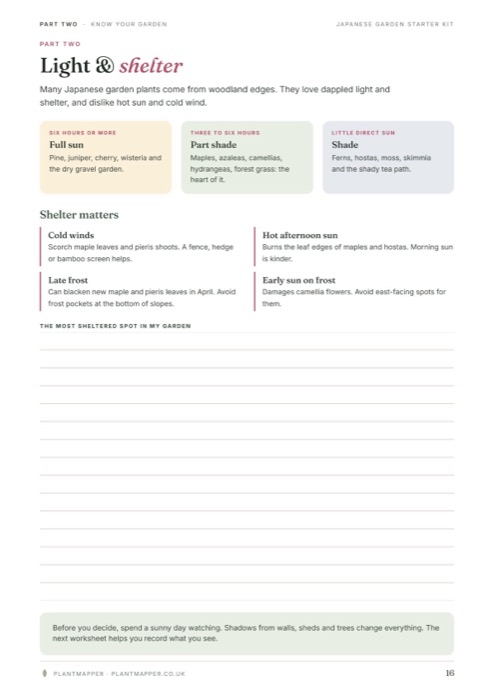
An instant digital download in US Letter and A4. Print it at home as often as you like and plan a calm, considered Japanese-style garden. Inside you will find a composition planner for placing rock, water and focal points, layout plans for courtyard, dry, stroll and tea gardens, a plant directory of maples, pines, azaleas and moss, a maple and pruning guide, seasonal care checklists and a garden journal. It sits alongside our Cottage, Mediterranean, Tropical, Shady and Wildlife garden kits.
Download the Starter Kit on Etsy (UK edition)A printable workbook for your own yard. A Japanese garden rewards patience: build it slowly, one considered element at a time.
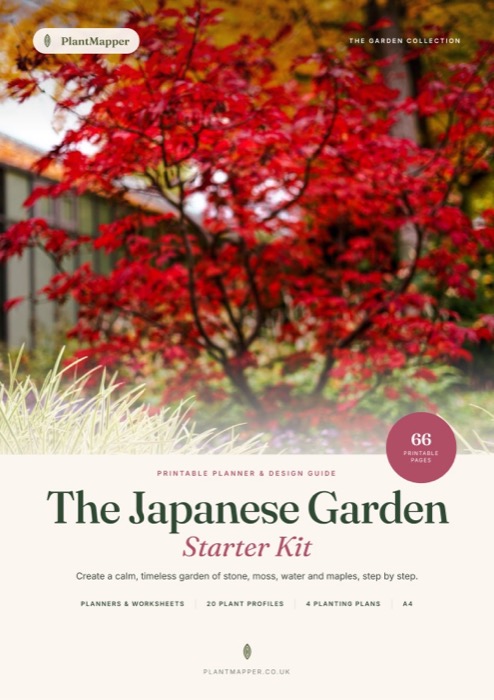 66-page printable planner · US Letter & A4
Some links on this page are affiliate links. If you buy through them, PlantMapper may earn a small commission at no extra cost to you. It never affects which products we suggest.
All advice is general guidance for yards across the US. Results vary with your zone, soil and rainfall, so confirm each plant's hardiness and invasive status in your state.
Some plants, including azaleas and yews, are toxic to pets and people, and water features need care near young children. Check local rules on pond depth and fencing, and choose clumping (not running) bamboo.
A Japanese garden is a calm, carefully composed space that recreates nature in miniature, using stone, gravel, water, moss and a small palette of plants such as maples and pines. It is designed for stillness, with balance, simplicity and symbolism rather than bold color.
Yes. Some of the most beautiful Japanese gardens are tiny courtyard gardens (tsubo-niwa). A single maple, a few well-placed rocks, a water basin and a patch of moss or raked gravel can make a complete scene in a side yard or townhouse patio.
Japanese maples (Acer palmatum) grow in USDA zones 5 to 8, and some forms manage zone 9 with good afternoon shade. In hot Southern and Southwestern summers they need protection from afternoon sun, and in zone 5 or in pots they need shelter from winter cold.
Yes. In the arid Southwest and much of California, a dry garden (karesansui) of raked gravel, boulders and a few drought-tolerant evergreens fits the climate and needs little water. Swap moss for gravel or a low sedge, give maples afternoon shade, and use pines, junipers and clumping grasses for structure.
Japanese barberry, Japanese spirea, Japanese honeysuckle, Japanese and Chinese wisteria, Japanese knotweed and running bamboo are invasive in many states, and Japanese pachysandra spreads into woodland in parts of the East. Check your state's invasive plant list and consider natives such as native azaleas, serviceberry, Pennsylvania sedge and American wisteria.
They are low-effort but not no-effort. There is little to water or feed once established, but the calm look depends on regular tidying: sweeping or blowing leaves, weeding moss, light pruning and keeping things simple. The reward is a restful garden that looks good all year.