
Ferns
Polystichum, Dryopteris, Osmundastrum, Adiantum
The signature of the style, and deer leave most alone. Evergreen Christmas fern in the East, western sword fern in the West, cinnamon and maidenhair ferns for moist spots.
If your yard has mature oaks, maples or tulip trees, you already have the hardest part of a woodland garden. Instead of fighting thin grass in the shade, plant the way an Eastern hardwood forest or a Pacific Northwest understory grows: a light canopy, native shrubs, ferns and spring wildflowers like trillium and Virginia bluebells. Even one small tree or a north-facing bed is enough to start.
A woodland garden is grown, not bought. Keep your fallen leaves, plant in layers and give it a couple of seasons. In deer country, plan for protection from day one.

A woodland garden copies the structure of a real forest at yard scale: an open canopy, an understory of small trees and shrubs, woodland perennials, and a floor of ferns, groundcovers and spring ephemerals that bloom before the trees leaf out. It thrives in dappled shade and leaf-rich soil, exactly what most suburban lots have under their big trees. Built mostly from plants native to your region, it also feeds birds and pollinators, and once it settles it needs less work than the struggling lawn it replaces.
Filtered light and layers of green give a woodland garden a stillness few other styles match, and it stays cooler on hot summer days.
Layered planting covers the soil, smothers weeds and holds moisture. Shredded fall leaves left in the beds do most of the mulching for free.
The shady spots where grass gives up are exactly where woodland planting is happiest. The problem becomes the point.
Leaf litter, native shrubs and spring wildflowers feed and shelter wood thrushes, native bees, fireflies, toads and salamanders.
Spring ephemerals, summer ferns, fall color from native shrubs and evergreen bones in winter: there is always something to see.
A wooded lot, a single shady bed or a north-facing side yard: the woodland look scales down to small spaces.
Layered, natural planting in dappled shade: ferns, native wildflowers and shrubs under a light canopy.
You are hereCool, leafy planting for low light, the closest cousin, focused on foliage in deeper shade.
Planned for nature, a natural partner to a woodland garden's leaf litter and native plants.
Romantic, flower-filled beds; many cottage favorites enjoy a little dappled shade too.
Easy-care planting with minimal fuss; an established woodland garden is one of the most relaxed of all.
Some inspiration before you plan: dappled light, spring flowers and the cool, layered planting that thrives beneath trees.


The secret is layering. A forest stacks plants from the treetops to the leaf-covered floor, with no bare gaps. Recreate these four layers, even in a small yard, and the planting instantly reads as natural. Choose species native to your region where you can.
Keep existing oaks and maples, or plant an airy tree such as river birch, serviceberry, flowering dogwood or redbud. Limb up low branches to let light through.
Native shrubs such as oakleaf hydrangea, spicebush, witch hazel, mountain laurel and fothergilla give structure, flowers and fall color. In the West, try vine maple and Oregon grape.
The leafy body: ferns, Solomon's seal, wild columbine, woodland phlox, hellebores and brunnera at knee to waist height.
A carpet of wild ginger, foamflower, Pennsylvania sedge, epimedium and spring ephemerals such as trillium and bloodroot, plus daffodils, which deer leave alone.
One plant from each layer is the quickest way to a planting that already looks like woodland. Then repeat and overlap until the layers knit together. Remove English ivy, vinca or pachysandra carpets first; they smother the natives you want.
Woodland shade is not one thing. Two questions decide everything: how much light and how much moisture your spot gets. Your region matters too: dry summer shade in California or Texas is very different from moist Appalachian or Pacific Northwest shade. Name your conditions first, then match the plants.
Under maples and big conifers, roots steal the water. Plant small plugs in fall, water through the first summer, and choose tough plants like epimedium, Pennsylvania sedge, wild geranium and Christmas fern.
Shady ground that stays moist is a gift. Ostrich and cinnamon ferns, turtlehead, cardinal flower, astilbe and Virginia bluebells flourish with almost no effort.
Sun broken into shifting light by a high canopy, the woodland-edge light most woodland plants love. In hot Southern summers it is the ideal spot.
Little or no direct sun: a north wall, a narrow side yard, under dense evergreens. Use the toughest foliage, such as ferns, wild ginger, bergenia and sedges. Skip English ivy, which is invasive in many states.
How to tell which you have: check the spot at 9 a.m., 1 p.m. and 5 p.m. in midsummer, when the trees are in full leaf, then dig a hole a day after rain to see how moist it stays. Light and moisture decide every choice that follows.
These ten groups are reliable, easy to find and happy out of the sun across most of the country (roughly zones 4-8; check your growing zone). Deer are the biggest threat to woodland gardens in much of the US, so each card says how they fare. Filter more plants by light and soil in the Plant Finder.
Polystichum, Dryopteris, Osmundastrum, Adiantum
The signature of the style, and deer leave most alone. Evergreen Christmas fern in the East, western sword fern in the West, cinnamon and maidenhair ferns for moist spots.
Helleborus orientalis & hybrids
Late-winter flowers over evergreen leaves, zones 4-9. Toxic, so deer and rabbits leave them alone, which makes them a staple in deer country.
Epimedium · barrenwort
One of the best groundcovers for dry shade under maples, zones 5-8. Dainty spring flowers over heart-shaped leaves, and deer resistant.
Digitalis purpurea
Woodland spires loved by bumblebees and ignored by deer (all parts are poisonous). A biennial, zones 4-8. In the Pacific Northwest it seeds into forests, so deadhead there.
Trillium, Mertensia, Sanguinaria, Anemone quinquefolia
Trillium, Virginia bluebells, bloodroot and our native wood anemone bloom before the trees leaf out, then fade away. Buy nursery-propagated plants, never ones dug from the wild, and fence trilliums from deer.
Pulmonaria · lungwort
Early pink-and-blue flowers over silver-spotted leaves, zones 3-8. Deer resistant, but give it afternoon shade and even moisture in hot summers.
Brunnera macrophylla
Airy blue spring flowers over heart-shaped leaves, zones 3-8, and deer resistant. Silver-leaved kinds glow in shade; prefers cooler Northern summers.
Hosta
Bold leaves for damp shade, zones 3-9, but they are a favorite deer food. Where deer roam, use ferns, wild ginger or Solomon's seal instead, or spray repellent faithfully.
Anemone hupehensis / × hybrida
Tall pink or white flowers from late summer into fall, zones 4-8, and deer resistant. It spreads by runners once settled, so give it room.
Carex pensylvanica, Carex plantaginea, Hakonechloa, Chasmanthium
Native Pennsylvania sedge makes a soft, no-mow carpet under trees, and river oats add movement at the woodland edge. Japanese forest grass is a well-behaved extra.
Invasives to pull before you plant. The biggest threats to American woodland gardens are already in many yards: English ivy, vinca (periwinkle), Japanese pachysandra in parts of the East, garlic mustard, Japanese stiltgrass, lesser celandine, bush honeysuckle, burning bush, Japanese barberry and Norway maple seedlings. Remove them gradually and replace them with natives so the ground isn't left bare. Check your state's invasive plant list for local problem plants.

The look seems effortless, but a few simple principles hold it together. Use these and the planting will feel natural and intentional rather than busy or bare.
Build from canopy to floor so green fills every level. Layered planting reads as forest; a row of foundation shrubs in mulch never will.
Plant in generous, irregular drifts that flow into one another, the way plants spread in the wild, rather than dotting one of everything.
Repeat a few reliable plants through the scheme. Recurring ferns or hellebores give a calm rhythm that ties the whole garden together.
Layer the calendar too: spring ephemerals, summer ferns, fall color from witch hazel and fothergilla, and evergreen winter bones.
With fewer flowers than a sunny bed, woodland planting lives on texture: lacy fronds, bold leaves, soft sedges and glossy evergreens together.
Set big against fine, glossy against matte, green against silver. A broad mayapple leaf beside a lacy maidenhair fern is the essence of woodland design.
The golden rule: lead with foliage, not flowers. Get the leaves working together, keep the fallen leaves as mulch, and the woodland feeling follows.
Woodland color is gentle: greens upon greens, lifted by soft flower tones and the occasional flash of silver or white. Here are four calm palettes to plant by.
Virginia bluebell blue, trout lily yellow and trillium white scattered through fresh new green: an Eastern hardwood forest in April.
Silver and variegated foliage (brunnera, pulmonaria, painted fern) with white flowers that seem to glow. Best where you need to brighten deep shade.
A deep, all-green scheme of ferns and foliage, grounded by a warm bronze note and pale stone. The calmest woodland palette of all.
Wild columbine red, woodland phlox lavender, celandine poppy yellow and spicebush over deep green: native colors that feed local bees and birds best.
Most woodland-garden problems come from working against the conditions, or against the deer, rather than with them.
Woodland plants spread over a season or two. Plant too tightly and they compete. Give them room and let them knit together.
Sun lovers never thrive in shade, and invasive groundcovers like English ivy and vinca take over. Choose true woodlanders, ideally native.
Woodland plants want cool, moist, leaf-rich ground. Bagging every leaf each fall starves the soil. Shred them and leave them in the beds.
Reseeding thin lawn under trees every year is a losing battle. Embrace the shade and plant the foliage that loves it.
A new planting of hostas, trilliums and azaleas can vanish overnight. Choose deer-resistant plants, fence young beds, or use repellents from day one.
Four ready-made ideas for the most common shady situations in American yards. Use one as is, or swap in natives from your region.
A complete, layered woodland in one shady bed, built from plants deer usually skip. It looks established within two seasons.
Every plant copes with dry shade. Plant plugs in fall, water through the first summer, and the bare ground under a big tree becomes a glade.
Moist shade is where woodland planting flourishes with the least effort. This scheme all but grows itself.
The woodland edge, where shade meets sun, is the richest habitat of all, and this scheme makes the most of that gentler light.

Filter plants by your light, soil and space. These shortcuts are a good place to start a woodland planting.
Plan the practical side of new woodland beds with our free calculators.
As an Amazon Associate, PlantMapper may earn from qualifying purchases. Prices and availability are set by Amazon.
Give the planting a couple of seasons under the canopy and the bare ground beneath the trees fills with layered ferns, foliage and spring color in dappled light.

Everything on this page is free: the layers, conditions, plant groups and schemes. The Woodland Garden Starter Kit is an optional printable workbook for planning the garden on paper. It was written for the original edition of PlantMapper, so swap in native plants for your region using this page, our free garden calculators and the Plant Finder.
Worksheets to read your light and moisture honestly, so you plant the right woodlander in the right spot from the start.
Ready-made and blank planting plans for each layer (canopy, shrub, herbaceous and floor) with reliable combinations.
Season-by-season checklists of what to mulch, divide, plant and leave, so the garden looks after itself.
Profiles of woodland plants (ferns, hellebores, woodland perennials and bulbs) matched to the shade and soil they like.
Scaled and dot grids for sketching your beds to size, with a key for canopy, understory and woodland floor.
Pages to record what thrived, what flowered and what you will try next year.
An instant digital download in US Letter and A4. Print it at home as often as you like and plan a layered woodland garden, canopy to floor. Inside you will find a woodland plant directory of ferns, hellebores and bulbs, layering plans for every level, shade-and-soil mapping worksheets, design grids, seasonal care checklists and a garden journal. It sits alongside our Cottage, Mediterranean, Tropical, Shady and Wildlife garden kits.
Download the Starter Kit on Etsy (UK edition)A printable workbook for your own yard. A woodland garden is grown, not bought: plant it in layers and give it time.
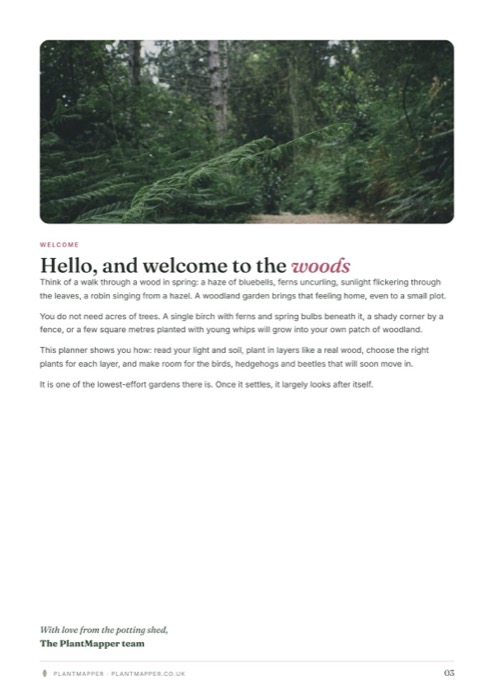
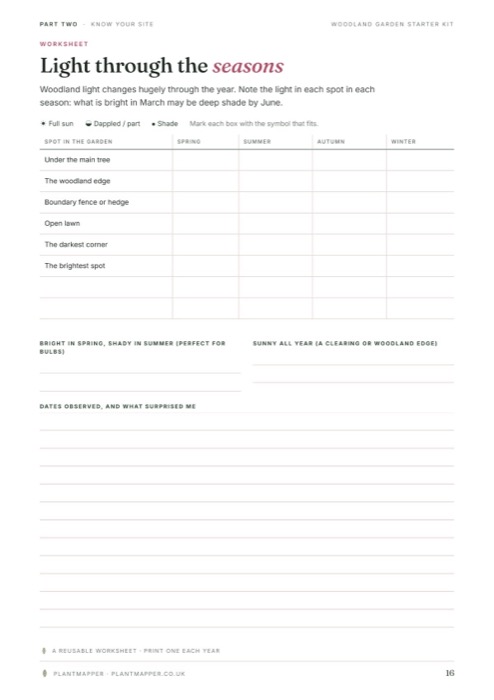
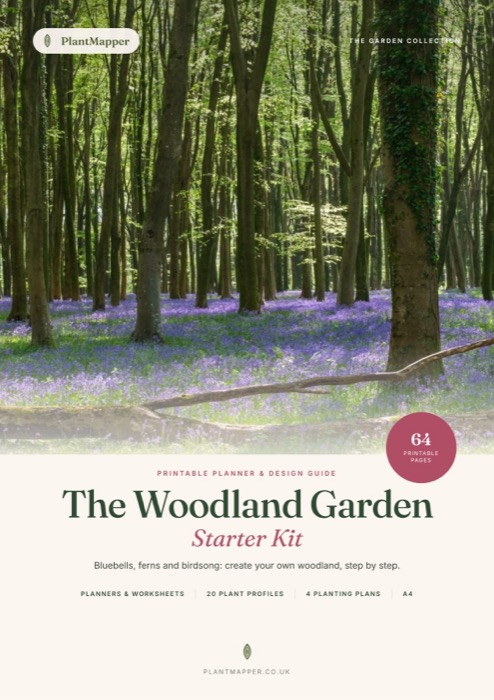 64-page printable planner · US Letter & A4
Some links on this page are affiliate links. If you buy through them, PlantMapper may earn a small commission at no extra cost to you. It never affects which products we suggest.
All advice is general guidance for yards across the US. Native ranges, zones and invasive lists vary by region, so check plants with your state's native plant society or extension service.
Some woodland plants, including foxglove, hellebore, mayapple and bloodroot, are toxic if eaten. Check each plant before growing it where children or pets play, and wear gloves when handling.
A woodland garden recreates the relaxed, layered planting of a natural forest: a light tree canopy, a shrub layer, woodland perennials and a floor of ferns, groundcovers and spring wildflowers, all enjoying dappled shade and leaf-rich soil.
Yes. One small tree such as a serviceberry or dogwood, a north-facing bed or the shady side of the house gives enough shade for woodland planting. Even a shady patio can hold a miniature woodland in pots.
In Eastern and Midwestern yards, try Christmas fern, wild ginger, foamflower, wild geranium, Solomon's seal, Virginia bluebells, trillium, woodland phlox and Pennsylvania sedge, with oakleaf hydrangea, spicebush or witch hazel as shrubs. In the Pacific Northwest, use western sword fern, vine maple, Oregon grape and salal. A local native plant society can suggest species for your area.
Most ferns, hellebores, epimedium, foxglove, brunnera, pulmonaria, wild ginger, Japanese anemone and daffodils are rarely eaten by deer. Hostas, trilliums, azaleas and tulips are deer favorites, so fence them or choose alternatives where deer are common. No plant is completely deer-proof when deer are hungry.
Once established, yes. Layered planting covers the soil, holds moisture and needs little watering or fertilizer, and shredded fall leaves left in the beds do most of the mulching. The main jobs are keeping invasive plants out and protecting new plantings from deer.