

Quick answers
- When is the best time to plant an apple tree?
- Plant bare-root trees in early spring as soon as the ground can be worked in zones 3-6, and from late fall through winter in mild zones 7-9. Container trees can go in any time the ground isn’t frozen, if watered well.
- When should I prune an apple tree?
- In late winter while the tree is dormant, after the coldest weather has passed but before buds open. Light summer pruning to remove water sprouts is fine too.
- Do apple trees need a pollinator?
- Almost always. Plant a second, different apple or a crabapple that blooms at the same time within about 50 ft. A neighbor’s tree may do the job, but don’t rely on it.
- Which apple tree is best for a small yard?
- Any variety on a dwarfing rootstock such as G.41, G.11 or Bud.9, which keeps the tree to roughly 8-10 ft. Grow two compact trees, or a cordon or espalier along a fence.
Why grow apples?
Apples are the most widely grown home fruit in the country for good reason: they adapt to a huge range of climates, live for decades and can store for months. And with more than a thousand varieties available from US nurseries, you can grow apples you’ll never see in a supermarket.
Flavors stores don’t sell
Supermarkets stock a dozen apples chosen for shipping and shelf life. At home you can grow russets, heirlooms like ‘Arkansas Black’ and ‘Northern Spy’, or modern disease-resistant varieties bred for flavor.
Cold-hardy to zone 3
Apples are among the hardiest fruit trees: Minnesota-bred varieties such as ‘Honeycrisp’ and ‘Haralson’ survive brutal northern winters.
Months of fruit
Plant early, mid and late varieties and you can pick from late July into November, then store the keepers in the fridge into winter.
Fits any yard
On a dwarfing rootstock, an apple can be an 8 ft tree, an espalier on a fence, or a pair of trees in a narrow side yard.
Apples in the Fruit Trees & Bushes collection
Apple Trees
America’s favorite home fruit tree - varieties for cold, heat and everything between.
You are herePear Trees
Apple’s graceful cousin - long-lived, productive and easy to grow in much the same way.
Cherry Trees
Sweet or tart cherries on dwarfing rootstocks for yards of any size.
Plum Trees
Quick-cropping stone fruit, with types for every zone from 3 to 9.
Grow Your Own
Vegetables, herbs and salad greens to grow alongside your fruit.
Best apple varieties for US gardens
Choose by climate first. Most apples need 800 or more winter chill hours and suit zones 4-7; a handful of low-chill varieties fruit in zones 8-9; and Minnesota and Canadian breeding has produced apples for zones 3-4. Then choose for disease resistance - especially in the humid East - and for when the fruit ripens and how long it keeps.
‘Honeycrisp’
Explosively crisp, sweet-tart and cold-hardy into zone 3/4 - bred at the University of Minnesota. Best in the North; in hot summers it colors poorly and can suffer bitter pit.
‘Gala’ & ‘Fuji’
Two popular sweet eating apples. ‘Gala’ ripens in late summer and is widely adapted; ‘Fuji’ needs a long, warm season and keeps for months - a good choice in California and the South.
‘Liberty’ & ‘Enterprise’
Disease-resistant workhorses for the humid East and Midwest: resistant to apple scab and cedar-apple rust, with good fire blight tolerance. ‘Enterprise’ is a late, long-keeping apple.
‘GoldRush’ & ‘Pristine’
Scab-resistant varieties from the Purdue-Rutgers-Illinois program. ‘Pristine’ is an early yellow apple; ‘GoldRush’ ripens late and stores into spring (though it is susceptible to cedar-apple rust).
‘Anna’ & ‘Dorsett Golden’
Low-chill apples for zones 8-9, coastal California and parts of Florida and Texas. They pollinate each other and ripen in early summer.
Heirlooms & cider apples
‘Arkansas Black’ and ‘Black Twig’ for the South, ‘Northern Spy’ and ‘Wolf River’ for the North, and tannic cider apples for hard-cider makers. Most heirlooms need more spraying than modern resistant varieties.

New to apples? In the North and East, plant a disease-resistant pair such as ‘Liberty’ and ‘Enterprise’ (add ‘Honeycrisp’ in zones 3-5). In zones 8-9, plant ‘Anna’ with ‘Dorsett Golden’. Check your zone first: find your growing zone by ZIP code.
Apple rootstocks explained
Nearly every apple you buy is a variety grafted onto a rootstock. The rootstock controls the final size, how soon it fruits, how well it handles your soil and cold - and, with the newer Geneva stocks bred at Cornell, how well it resists fire blight and root rot. Heights below are approximate.
Bud.9 & M.9 - dwarf
Keep a tree to roughly 8-10 ft and fruit in two to three years. Shallow roots mean they need a permanent stake or trellis. Bud.9 is very cold-hardy.
Geneva G.11, G.41 & G.935
Cornell’s Geneva series are dwarf to semi-dwarf stocks (G.41 roughly M.9 size, G.935 a little larger) with good resistance to fire blight and crown rot - a smart choice in the humid East and on replant sites.
M.26 & M.7 - semi-dwarf
Make trees of roughly 12-16 ft. M.7 is widely sold and adaptable; M.26 is quite susceptible to fire blight, so avoid it where the disease is common.
M.111 (MM.111) - semi-standard
A vigorous, well-anchored stock giving a 15-20 ft tree. Tolerates drought and a range of soils - popular in the South, the Plains and for larger yards.
Seedling & Antonovka - standard
Full-size trees of 20-30 ft that take years to bear but are extremely hardy and long-lived. Antonovka is often used in the coldest northern states.
How to choose
Small yard or espalier: Bud.9, G.11 or G.41 with support. Average yard, free-standing tree: G.935 or M.7. Dry or poor soil and room to spare: M.111. Zone 3 extremes: Bud.9 or Antonovka.
Dwarf trees need support for life. Bud.9, M.9 and most Geneva dwarfs have brittle or shallow roots, so give them a sturdy post or wire trellis at planting and keep it there.
Apple pollination
Apples need pollen from a different apple variety that blooms at the same time, carried by bees. In most neighborhoods with other apples or flowering crabapples within a few hundred feet you’ll get some fruit, but planting your own compatible pair is the only way to be sure.
Plant two varieties
Choose two varieties with overlapping bloom times and plant them within about 50 ft of each other. Nursery catalogs usually list bloom times or compatible partners.
Crabapples count
Many flowering crabapples are excellent apple pollinators. A native crabapple or a variety such as ‘Dolgo’ can double as an ornamental and a pollen source.
Watch out for triploids
‘Jonagold’, ‘Mutsu’ (‘Crispin’) and ‘Gravenstein’ produce poor pollen. Plant them with two other varieties so all three set fruit.
Low-chill pairs
In zones 8-9, bloom times are unusual - pair ‘Anna’ with ‘Dorsett Golden’ or ‘Ein Shemer’, which flower at the same early time.

Support the bees. Native bees such as mason bees and bumble bees are excellent apple pollinators. Avoid insecticide sprays while trees are in bloom, and plant early-flowering natives like serviceberry and redbud nearby.
Planting an apple tree
Bare-root trees are cheapest and establish best. Plant them in early spring as soon as the soil can be worked in zones 3-6, and in late fall to winter in zones 7-9, where roots grow through the mild months. Container trees can be planted any time the ground isn’t frozen, though spring and fall are easiest.
Sun and air
Choose a site with at least 6-8 hours of direct sun and good air movement, away from low frost pockets and from where an old apple tree recently grew.
Graft above ground
Dig wide and no deeper than the roots. Keep the graft union 2-3 in above the soil - if it’s buried, the variety can root and the dwarfing effect is lost.
Stake, guard and fence
Fit the stake or trellis at planting, a trunk guard against rabbits and voles, and a wire cage or fence against deer, which browse young apple trees heavily.
Water and mulch
Water deeply after planting and weekly through dry spells for the first two summers. Keep a 3 ft ring of wood-chip mulch free of grass and weeds.
Remove the first fruit. Pinch off any fruitlets in the first year or two so the tree puts its energy into roots and branches. It will repay you with bigger crops for decades.
Soil & sun for apples
Apples adapt to most soils as long as they drain. They crop best in full sun on a deep loam, and they need good air movement to keep leaves dry and diseases down.
Full sun
Eight hours of sun is ideal for color, sweetness and next year’s flower buds. Shaded trees fruit poorly and suffer more disease.
Deep, well-drained soil
Loam is ideal, but apples handle clay if it drains. In poorly drained ground, plant on a broad mound and choose a rootstock tolerant of wet soils such as G.935 or M.111.
pH 6.0-7.0
Slightly acidic to neutral soil suits apples. A soil test through your county extension office tells you whether to add lime or sulfur before planting.
Away from junipers
In the East and Midwest, cedar-apple rust spreads from eastern red cedar and other junipers. Plant resistant varieties if junipers grow nearby.

Growing apples across the US
Apples grow from about USDA zone 3 to zone 9 - but the best variety for Vermont is rarely the best for Georgia or Arizona.
Northeast & Midwest
Classic apple country with cold winters, but also humid summers that bring scab, cedar-apple rust, apple maggot and plum curculio. Disease-resistant varieties and Geneva rootstocks save a lot of spraying; Minnesota varieties like ‘Honeycrisp’ suit zones 3-5. Fence against deer.
Southeast & Gulf Coast
Heat, humidity and fire blight are the challenges. Choose blight-tolerant, long-season apples such as ‘Arkansas Black’, ‘Fuji’ or ‘GoldRush’ in the upper South, and low-chill ‘Anna’ and ‘Dorsett Golden’ near the coast.
Southwest & California
Long, sunny seasons ripen ‘Fuji’, ‘Granny Smith’ and ‘Pink Lady’ beautifully. Irrigate deeply, mulch, and protect trunks from sunscald. Low deserts and the coast need low-chill varieties; alkaline soils may need iron supplements.
Pacific Northwest
Washington is the nation’s apple capital. East of the Cascades almost anything grows with irrigation; west of the Cascades, wet springs mean scab and anthracnose, so pick resistant varieties. Some areas have apple maggot quarantines on moving homegrown fruit.
Mountain West & Plains
Cold, wind, hail and late frosts. Plant hardy varieties (‘Haralson’, ‘Honeycrisp’, ‘Zestar!’) on hardy rootstocks such as Bud.9 or Antonovka, use a windbreak, and wrap young trunks against winter sunscald.
Native companions
Native crabapples (Malus coronaria, Malus ioensis) can help with pollination and feed wildlife, and early-blooming natives such as serviceberry and redbud support the bees your apples depend on.
Know your chill hours. Most apples need 800 or more winter hours between about 32°F and 45°F to flower well. In zones 8-9 and coastal California, choose varieties rated for a few hundred hours or fewer - your county extension office can tell you what your area gets.
Watering & feeding
Established apples in the rainy East rarely need watering except in drought; in the arid West they need regular irrigation all season. Young trees and dwarfs everywhere need steady water.
Deep weekly watering
Give young trees roughly 5-10 gallons once a week in dry weather, delivered slowly so it soaks in. Drip irrigation is ideal in the Southwest and California.
Feed by growth
If a young tree grows less than about 12 in a year, a spring application of balanced fertilizer helps. If it’s growing strongly, skip it - too much nitrogen invites fire blight.
Calcium for keepers
Bitter pit (small brown spots in the flesh) is linked to low calcium and uneven water. Keep watering even, and ask about calcium sprays if ‘Honeycrisp’ is affected.
Pots need more
Apples in containers dry out fast - water whenever the top inch of potting mix is dry and feed lightly through the growing season.
Mulch is the best fertilizer. A ring of wood chips feeds the soil as it breaks down, holds moisture and keeps lawn grass from competing - usually all an established apple needs.
Pruning apple trees
Prune apples in late winter while they’re dormant - after the coldest weather has passed but before buds open (roughly February to early April depending on your zone). Trained forms such as espaliers get a light trim in summer too. Our fruit tree pruning guide shows each step.
Central leader
Most US home apples are trained to a central or modified central leader: one main trunk with tiers of well-spaced side branches, wider at the bottom like a Christmas tree.
The three Ds first
Remove dead, damaged and diseased wood, then crossing and inward-growing branches, then water sprouts and root suckers.
Don’t overdo it
Take out no more than about a quarter of the canopy in a year. Heavy cuts trigger a flush of water sprouts and fewer apples.
Fire blight caution
Where fire blight is common, prune in dry late-winter weather, and cut out any blighted shoots in summer 8-12 in below the damage, disinfecting your pruners between cuts.
Thin the fruit
About four to six weeks after bloom, thin fruitlets to one per cluster, about 6 in apart. Bigger apples, fewer broken limbs and an annual crop.
Espaliers and cordons
Trained trees on dwarf stocks are shaped in late winter and trimmed in mid to late summer to keep their lines neat.
Late winter, light hand. A yearly late-winter prune that keeps the tree open to light, plus summer thinning of the fruit, does more for your crop than any spray.
Common apple problems in the US
Apples have more pests and diseases in North America than in most of the world, especially in the humid East. Disease-resistant varieties, good sanitation and a few targeted measures handle most of them. Your county extension office publishes home-orchard spray guides for your region if you need them.
Codling moth
The classic “worm in the apple,” found across the country. Pheromone traps time the flights; bagging young fruit in nylon footies or paper fruit bags is a proven home method.
Apple maggot & plum curculio
Apple maggot tunnels the flesh (Northeast, Midwest and parts of the West, where some areas have quarantines); red sticky spheres trap the flies. Plum curculio leaves crescent scars east of the Rockies - kaolin clay sprays help.
Fire blight
A bacterial disease that blackens shoots like a shepherd’s crook, worst in warm, humid springs. Choose resistant varieties and rootstocks, avoid excess nitrogen, and cut out infections in dry weather.
Apple scab & cedar-apple rust
Scab leaves olive spots on leaves and fruit in wet springs; cedar-apple rust makes orange leaf spots where junipers grow nearby. Resistant varieties such as ‘Liberty’ and ‘Enterprise’ avoid both.
Japanese beetles & mites
Japanese beetles skeletonize leaves in midsummer in the East and Midwest - shake them into soapy water each morning. Spider mites bronze leaves in hot, dry Western summers.
Deer, voles & rabbits
Deer browse shoots and fruit; voles and rabbits girdle trunks in winter. Use trunk guards, keep mulch pulled back from the bark, and fence trees in deer country.
Resistant varieties are the biggest shortcut. In the humid East and Midwest, growing ‘Liberty’, ‘Enterprise’, ‘Pristine’ or ‘Freedom’ on a Geneva rootstock can cut spraying dramatically compared with ‘McIntosh’ or ‘Honeycrisp’.
Harvesting apples
Depending on variety and region, apples ripen from late July to November. Early apples are for eating straight away; late-season keepers are picked firm and stored.
Lift and twist
A ripe apple comes away when you lift it level and give a gentle twist. If you have to pull, it’s not ready.
Check the seeds and color
Ripe apples have brown seeds and a background color that changes from green to yellow or cream under the blush.
Know your season
Early varieties like ‘Pristine’ and ‘Zestar!’ ripen from late July; ‘Honeycrisp’ and ‘Gala’ in late summer; ‘Fuji’, ‘GoldRush’ and ‘Pink Lady’ in October and November.
Handle gently
Bruised apples rot in storage. Place, don’t drop, them into a padded bucket or picking bag.

Storing apples
Late-season apples can keep for months if stored cold and humid. A spare refrigerator in the garage is the home grower’s secret weapon.
Cold and humid
Apples keep best at about 32-35°F with high humidity. Store them in perforated plastic bags in the refrigerator crisper or a spare fridge.
Choose keepers
‘Fuji’, ‘GoldRush’, ‘Enterprise’, ‘Arkansas Black’ and ‘Pink Lady’ can store for months. Summer apples like ‘Pristine’ last only a few weeks.
Keep them apart
Apples give off ethylene gas, which speeds ripening of other produce. Store them away from vegetables, and remove any with bruises or rot.
Sauce, butter and cider
Windfalls and bruised apples make applesauce, apple butter and fresh cider. Freeze sliced apples for pies, or dry rings in a dehydrator.
Store only perfect fruit. One rotting apple really does spoil the bunch. Check stored apples every couple of weeks and use any that are softening first.
Apple trees - frequently asked questions
The questions American apple growers ask most, answered simply.
How long does an apple tree take to bear fruit?
On a dwarfing rootstock such as Bud.9 or G.41, two to four years. Semi-dwarf trees take about four to six years, and full-size seedling trees can take six to ten.
Do I need two apple trees?
In nearly all cases, yes - or a crabapple or neighbor’s apple nearby. Plant two different varieties that bloom at the same time within about 50 ft of each other.
What zone do apple trees grow in?
Apples grow in roughly USDA zones 3-8, and into zone 9 with low-chill varieties. Hardy varieties such as ‘Honeycrisp’ and ‘Haralson’ take zone 3-4 winters; ‘Anna’ and ‘Dorsett Golden’ fruit in zones 8-9 with very little winter chill.
Can I grow apples in Texas, Florida or Southern California?
Yes, with low-chill varieties. ‘Anna’, ‘Dorsett Golden’ and ‘Ein Shemer’ need only a few hundred chill hours or fewer and are grown in coastal Southern California, the Gulf Coast and north and central Florida. Check your area’s chill hours with your extension service.
Why are there worms in my apples?
Usually codling moth (tunnels to the core) or apple maggot (brown trails through the flesh). Bagging young fruit, pheromone or sticky traps, and picking up dropped apples promptly all help.
Are apple trees deer resistant?
No. Deer browse apple shoots, buds and fruit and can ruin a young tree. Use a tall fence or a wire cage around each tree until it is well above browse height, and pick up dropped fruit, which draws deer in.
Practical tips
The habits that separate a thriving, cropping apple tree from a struggling one.
Choose for your climate
Match chill hours and hardiness to your zone - then pick for disease resistance.
Plant a pair
Two different apples blooming together are the surest route to a crop.
Pick the rootstock first
It decides the tree’s size, staking needs and fire blight risk.
Prune in late winter
Open the tree to light, and never remove more than about a quarter at once.
Thin the fruit
One apple per cluster, about 6 in apart, gives bigger fruit every year.
Guard against critters
Trunk guards for voles and rabbits, and a fence for deer.
Helpful garden calculators
Work out the soil, spacing and materials your trees need with our free calculators, so you plan and plant with confidence.
Useful for growing apples
Our picksAs an Amazon Associate, PlantMapper may earn from qualifying purchases. Prices and availability are set by Amazon.
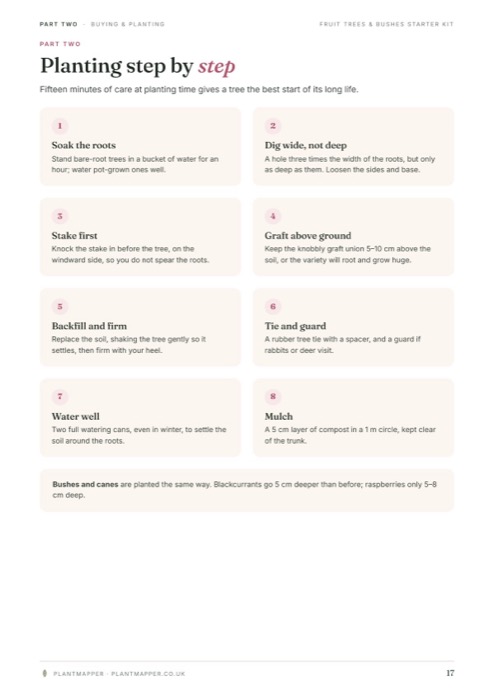
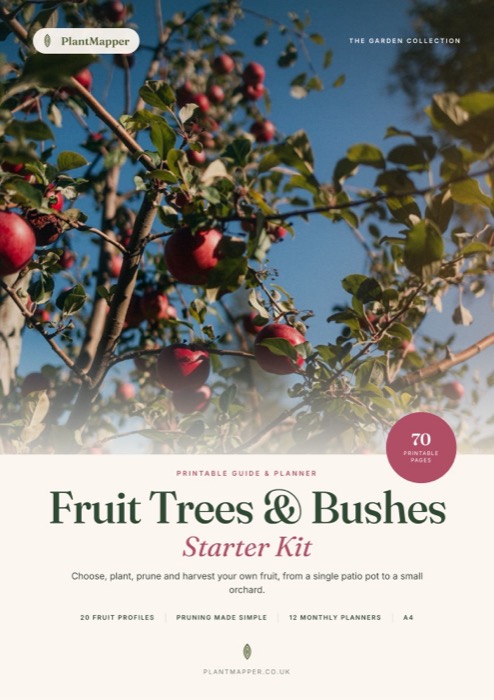
The Fruit Trees & Bushes Starter Kit
This apple guide is a cornerstone of our Fruit Trees & Bushes collection. Everything you need to choose, plant, prune and harvest a healthy apple tree is free on this page - the optional printable workbook is the calm next step for planning a whole orchard, away from the screen.
Download the Fruit Trees & Bushes Starter Kit
An instant digital download in A4 and US Letter - print it as often as you like and plan, plant and care for fruit trees and bushes. Inside you will find the Orchard Formula, rootstock and pollination planners, orchard layout grids, a fruit directory and seasonal trackers, all in the calm PlantMapper style. Part of the wider PlantMapper Collection.
Download the Starter Kit on Etsy (UK edition)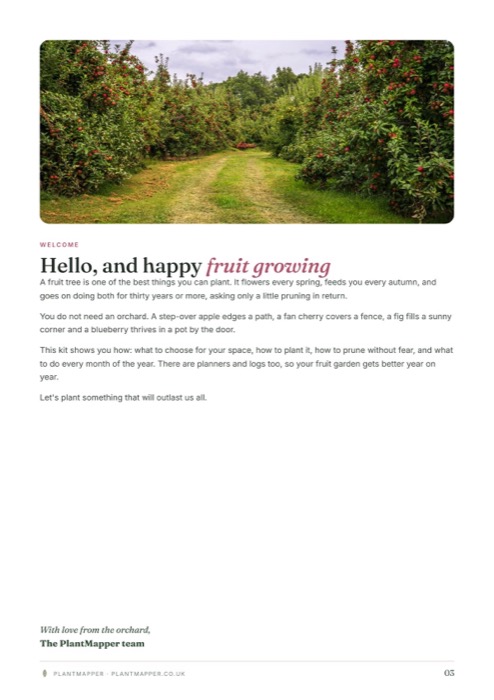
 70-page printable workbook · A4 & US Letter
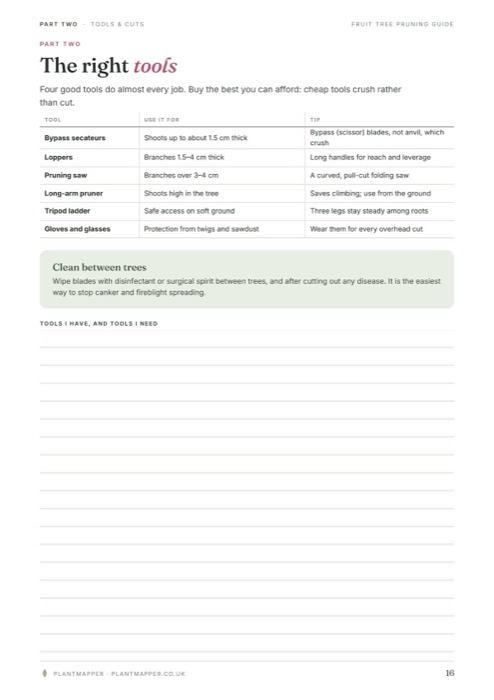
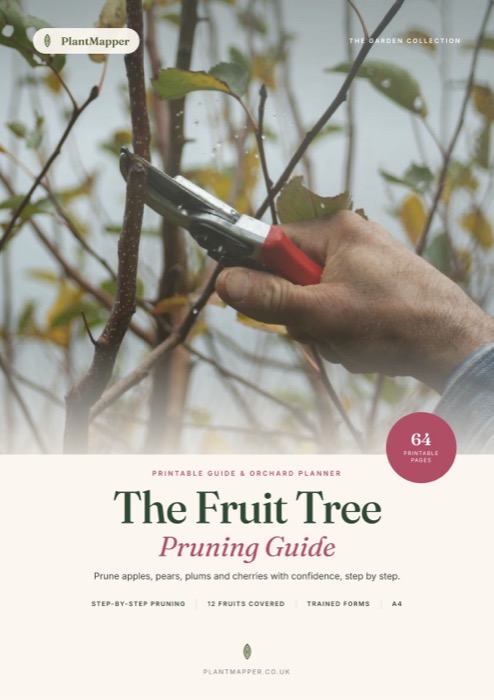
Download the Fruit Tree Pruning & Training Guide
An instant digital download in A4 and US Letter - print it as often as you like and prune and train healthy, productive fruit trees. Inside you will find the PlantMapper Pruning System, the Branch Priority Matrix, training-system selectors and formative-pruning timelines, plus field logs and trackers, all in the calm PlantMapper style. Part of the wider PlantMapper Collection.
Download the Guide on Etsy (UK edition)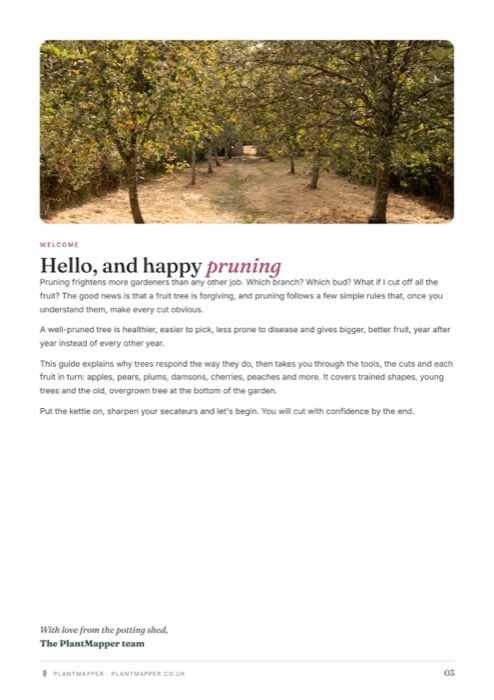
 64-page printable workbook · A4 & US Letter
Disclosures & disclaimers
Affiliate disclosure
Some links on this page are affiliate links. If you buy through them, PlantMapper may earn a small commission at no extra cost to you. It never affects which products we suggest.
Gardening disclaimer
All advice is general guidance for home gardens in the United States. Results vary with your zone, chill hours, soil and season - check variety, rootstock and pollination needs with a local nursery or your county extension office before you buy.
Food-safety note
Apple seeds and leaves should not be eaten in quantity. Wash homegrown fruit before eating, and follow label directions and pre-harvest intervals for any spray you use.